Prompt Cache Busting: Why Dynamic Tool History Destroys Your Cache Hit Rate (And How to Keep It at 90%)
Why naive agent loops bust LLM prompt caching, and the architectural prefix-pinning rules to maintain a 90%+ cache hit rate across multi-turn runs.
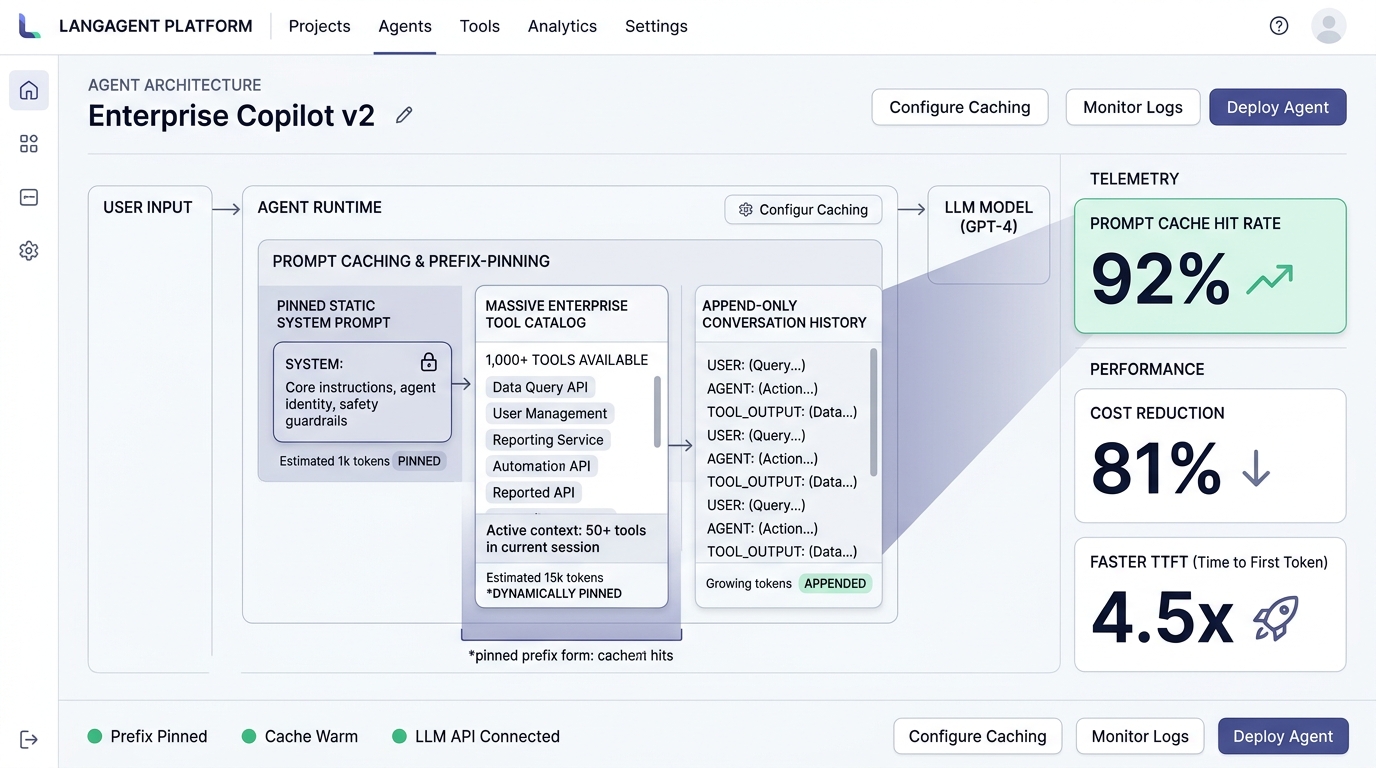
Prompt Cache Busting: Why Dynamic Tool History Destroys Your Cache Hit Rate (And How to Keep It at 90%)
Last month a team showed me their production agent logs. They built a capable coding agent running in sandboxes, but their inference bill had blown past $18,000 for a dozen developers.
The culprit was obvious in their token breakdown: their prompt cache hit rate was 4%.
Every turn of a 40-step agent loop was recomputing 50,000 prompt tokens from scratch. A run that should have cost $0.35 was costing over $4.00.
Prompt caching promises 75% to 90% cost cuts, but in multi-turn agent loops it is fragile. Here is why naive agent loops bust the cache, and how to lock in a 90%+ hit rate.
The Rule: Caching is Strictly Sequential
Every major LLM provider (Anthropic, OpenAI, DeepSeek, Google) caches prompt tokens strictly from left to right.
If token #10 changes, tokens #11 through #50,000 cannot be read from the cache. The entire downstream sequence must be recomputed at full input price.
Turn 1: [System (4k)] [Tools (25k)] [Turn 1 History (2k)]  -> Cache Written
Turn 2: [System (4k)] [Tools (25k)] [Turn 1 History (2k)] [Turn 2 (2k)] -> 31k Cache HIT

If token #5 changes in the system prompt:
Turn 2: [MUTATED System (4k)] [Tools (25k)] [History (4k)] -> 33k Cache MISS
3 Hidden Cache Killers
- Timestamps in the system prompt: Putting
Current time: 2026-10-27 10:14:02 UTCat the top of your prompt changes the prefix on every turn. Your cache resets to zero immediately. - Unsorted or dynamic tool schemas: When agents have hundreds or thousands of tools, schema definitions alone exceed 20,000 to 40,000 tokens. If your runtime serializes tools in non-deterministic order or swaps tools dynamically between turns, the token stream diverges before the conversation even starts. That destroys the entire tool cache on every single step.
- Rolling message pruning: Editing past turns to save 200 tokens invalidates the KV cache from that turn forward. You save pennies on context and spend dollars on recomputing cache misses.
The 4 Rules for a 90%+ Hit Rate
- Freeze the prefix: Keep your system prompt, core rules, and tool definitions 100% static across all turns. When managing 1,000+ tools, sort schemas alphabetically by name with deterministic key serialization so the tool catalog remains an immutable token sequence.
- Push dynamic state to the suffix: Your agent still needs timestamps and budget limits. Inject them into the tail of the latest user message or a trailing runtime block:
{"role": "user", "content": "[Runtime: 10:14:10 UTC | Turn 12/50]\nRun the test suite."} - Keep history append-only: Never edit past turns mid-flight. If you need compaction, do it at fixed milestones (e.g. every 20 turns) so you take one planned cache miss instead of twenty continuous misses.
- Sanitize tool returns: Strip millisecond execution timings, request IDs, and volatile headers before storing tool outputs in conversation history.
The Numbers
On a 30-turn session averaging 40k prompt tokens (Claude 3.5 Sonnet):
| Metric | Naive Loop | Prefix-Pinned Loop |
|---|---|---|
| Cache Hit Rate | ~4% | 92% |
| Cost per Run | $3.60 | $0.68 (81% cheaper) |
| Time-to-First-Token | 3.2s | 0.7s (4.5x faster) |
At Vicaro, our AI employees have access to 1,000+ enterprise tools across communication platforms, cloud infrastructure, code repositories, databases, and business systems. When an agent's tool catalog alone takes tens of thousands of tokens, prefix stability is not an optimization, it is survival. We bake deterministic schema sorting, immutable prefix pinning, and suffix-injected runtime state directly into our engine.
Before you downgrade to a smaller model to save money, check your prompt cache hit rate. Fixing your prefix ordering takes an afternoon and cuts your bill immediately.