The 2026 Guide to Hiring AI Employees for Enterprise Teams
Essential enterprise architecture for hiring AI employees: verified directory identity, isolated sandboxes, CEL guardrails, and tool orchestration.
The 2026 Guide to Hiring AI Employees for Enterprise Teams
Most teams adopting AI start with copilots. You give engineers or marketers an autocomplete window, they get a quick 10% speed boost on first drafts, and the workflow otherwise stays identical.
An AI employee is a fundamentally different architecture. Instead of waiting for a prompt, an AI coworker owns recurring schedules, monitors event triggers, holds persistent state across weeks of context, and calls enterprise tools directly to finish end-to-end work.
If you are looking to hire AI employees for your company in 2026, here is the architectural checklist and operational model that actually works in production.
1. Identity and Service Accounts Over Shared Logins
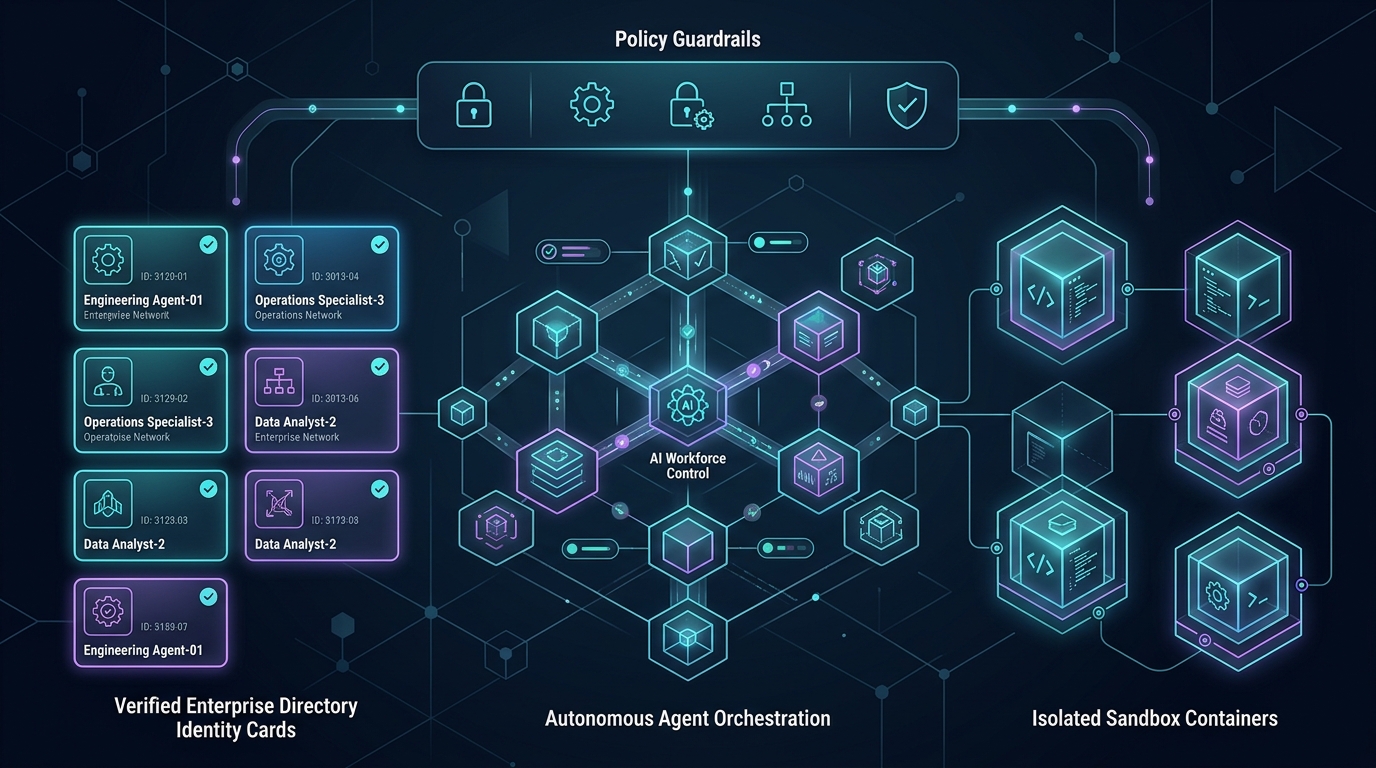
The fastest way an agent deployment fails security review is sharing human credentials. An AI coworker needs its own verified identity in your enterprise directory:
- Its own corporate email address and Google Workspace or Microsoft 365 identity.
- Dedicated Slack or Teams bot user IDs so team members can mention them naturally and audit their responses in public channels.
- Encrypted secret injection at runtime. Secrets should never be hardcoded into prompt templates or stored in plaintext logs. Placeholders resolve server-side at dispatch time, ensuring raw API tokens never enter stored conversational history.
2. Isolated Execution Sandboxes
Real work requires running scripts, parsing messy CSVs, and fetching external data. Giving an LLM direct access to production machines is an unnecessary risk.
Production agents run in containerized, ephemeral sandboxes. When an agent needs to execute Python, manipulate data, or generate a report, it spins up an isolated sandbox environment. When the task finishes, artifacts get saved to durable storage and the container is destroyed. This prevents shell escapes and keeps your primary network completely isolated.
3. CEL Guardrails and Human-in-the-Loop Policies
Autonomous execution does not mean unchecked authority. Enterprise teams need fine-grained policy engines gating high-blast actions.
At Vicaro, we use Common Expression Language (CEL) policy rules evaluated before every tool dispatch. Low-risk operations (reading a document, querying internal metrics, drafting an email) pass automatically. Destructive or external actions (deleting records, sending outbound campaigns, altering infrastructure) automatically pause the agent run and dispatch an interactive approval card to the responsible manager. The run resumes only when an authorized human clicks approve.
4. Multi-Tool Orchestration Across Enterprise Systems
An AI employee is only as useful as what it can touch. Rather than narrow point solutions limited to a single CRM or repository, enterprise agents need access to broad toolsets spanning communication, databases, code repositories, and custom APIs. When an agent can coordinate across 1,000+ enterprise integrations while adhering to strict permission boundaries, it stops being a chat toy and starts taking full functional ownership.